
Current Service Inquiry
Electrolyte Environment
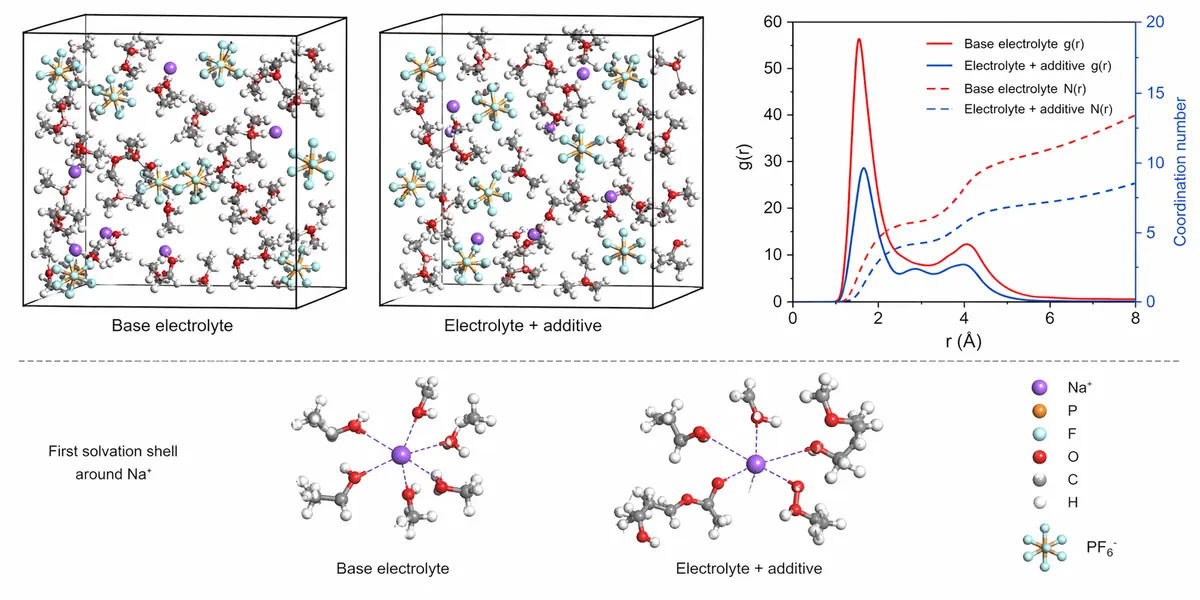
Calculation Purpose
Case Reference
Why is calculating the electrolyte molecular weight (MD) so expensive? What data do I need to prepare before hiring someone to do it? What results can I expect?
Anyone who has used agencies to perform electrolyte kinetic simulations knows that calculating the molecular dynamics (MD) of an electrolyte typically costs several times more than calculating binding energy, electrostatic potential, adsorption energy, and other parameters. Many people think that MD simulation is simply running a testing software program—you input molecules, click "Run," and get the graph. However, in reality, there's a lot of preparatory work required before "Running." How much work is involved, what data needs to be prepared before hiring someone to perform the calculation, and what results can you get afterward? This article will provide a detailed explanation.
JACS: Looking at electrode potential with MD, the second coordination shell is key
When the lithium-salt concentration increases, the electrode potential often shifts upward, and one usually starts from the coordination structure around Li⁺. This JACS work finds that in ionic liquids, the first coordination shell changes very little, yet the potential still rises substantially, showing that looking only at the anions immediately next to Li⁺ may miss the key contribution. Atsuo Yamada’s group at the University of Tokyo extends liquid Madelung theory to ionic liquids and, using all-atom molecular dynamics (MD) to calculate the electrostatic interactions between Li⁺ and surrounding species, shows that enhanced repulsion from an increased number of Li⁺ ions in the second coordination shell is an important reason for the potential upshift in such systems.
Scan the QR code with WeChat for free consultation
Email: chengyankeji2026@163.com
WeChat QR Code