
Battery / Porous materials and separation transport / Ion Diffusion
Nat. Commun.: MD + Metadynamics reveals the mechanism of fast Cl− transport
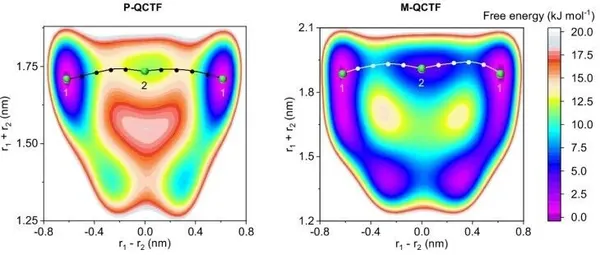
Read OriginalSub-nanometer channels can improve ion sieving, but the migration of anions such as Cl⁻ in confined spaces is often markedly slower. The team of Zhengjin Yang and Tongwen Xu at the University of Science and Technology of China tunes the pore-wall chemistry of covalent triazine framework membranes to accelerate Cl⁻ transport, and applies the membranes in a neutral aqueous organic flow battery. The theoretical work uses molecular dynamics, RESP charge analysis, and metadynamics to examine the membrane free volume, pore-wall charge distribution, Cl⁻ migration free energy, and ion–pore-wall interactions under different chemical modifications.
Read Original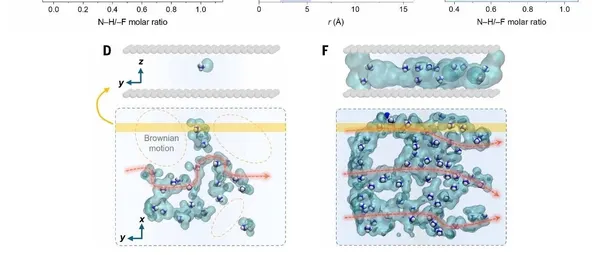
Porous materials and separation transport
Science: Why does water transport faster when ammonium ions rotate? DFT and MD analysis of the transport mechanism in MXene membranes
Read OriginalMXene interlayer channels are already narrow, and introducing additional ions often further restricts water transport. This Science work finds that after introducing NH₄⁺ into the MXene interlayer, water transports faster while ethanol is hindered. The authors link this to the rotation of ammonium: position-restricted NH₄⁺ can still reorient and help nearby water exchange and migrate. Combining DFT, AIMD, and classical MD, they explain, from stable configurations and rotational controls to hydration structure and migration trajectories, why ammonium stays in the channel and how it speeds up water transport.
Read Original