
Battery
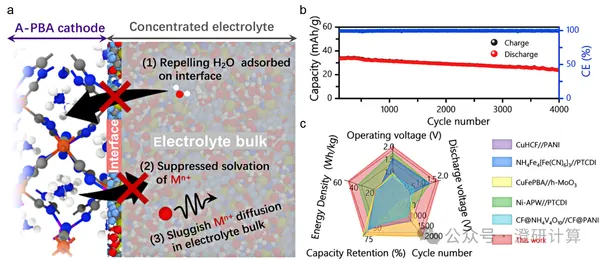
Interface distribution, free water, and diffusion coefficient: how molecular dynamics (MD) explains the dissolution failure of aqueous electrodes in three steps?
In aqueous batteries, Prussian blue and its analogues (PBA/PBAs) are very attractive: open structure, rapid diffusion, and low cost. However, in actual battery applications, many systems exhibit significant capacity degradation within a few dozen cycles. One common reason is the dissolution of transition metals: once metal ions like Mn/Fe begin to enter the electrolyte, the framework gradually becomes hollow/defective, causing a simultaneous drop in capacity and voltage plateau.
This 2022 ACS Energy Letters work may not be "new" in itself, but it demonstrates how to use theoretical calculations to break down experimental phenomena into essential microscopic dynamic steps and clearly reveal the mechanism using quantifiable indicators.
Read OriginalThis 2022 ACS Energy Letters work may not be "new" in itself, but it demonstrates how to use theoretical calculations to break down experimental phenomena into essential microscopic dynamic steps and clearly reveal the mechanism using quantifiable indicators.
Porous materials and separation transport / Battery / Ion Diffusion
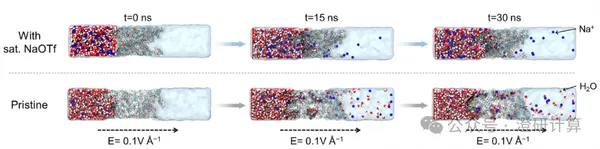
Case study from Nature Commun and Angewandte Chemie: How to use molecular dynamics (MD) to quantitatively analyze ion/water migration in membrane diffusion?
In battery development, experimental testing can tell us about macroscopic polarization and rate performance; however, how ions move within the membrane pores/interfaces often requires molecular dynamics (MD) to "see and explain."
In battery membrane research, MD primarily undertakes three core tasks:
1. Visualizing transport paths: Visualizing the abstract "ion channels," intuitively showing whether ions creep along polymer chains or diffuse freely in water-filled channels.
2. Quantifying selectivity mechanisms: Calculating the migration rate and flux ratio of different ions in the membrane through non-equilibrium (NEMD) simulations of applied external fields, directly quantifying membrane selectivity.
3. Analyzing solvation effects: Accurately calculating the coordination number of ions, revealing the energy cost of "desolvation" or "water-carrying migration."
Read OriginalIn battery membrane research, MD primarily undertakes three core tasks:
1. Visualizing transport paths: Visualizing the abstract "ion channels," intuitively showing whether ions creep along polymer chains or diffuse freely in water-filled channels.
2. Quantifying selectivity mechanisms: Calculating the migration rate and flux ratio of different ions in the membrane through non-equilibrium (NEMD) simulations of applied external fields, directly quantifying membrane selectivity.
3. Analyzing solvation effects: Accurately calculating the coordination number of ions, revealing the energy cost of "desolvation" or "water-carrying migration."
Battery
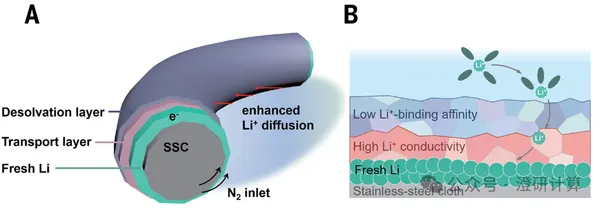
Science Computation Intensive Reading: How to Use Multi-Scale Computation CMD, AIMD, ReaxFF, and COMSO to Completely Understand the Multi-Scale Mechanism of the SEI Interface?
The solid electrolyte interface (SEI) plays a crucial role in both battery storage and electrocatalysis systems. However, experimental characterization often only provides macroscopic electrochemical performance, making it difficult to directly observe the dynamic evolution of ions at the interface. If we want to thoroughly explain the mechanism of the SEI in a top-tier journal, what can theoretical calculations do?
Read Original![[CEI Calculation] Wang Chunsheng's In-depth Reading of Nat. Chem. Calculation - How exactly is the positive electrode interface membrane (CEI) calculated?](https://img.chengyankeji.cn/uploads/optimized/1776753566297-20260312-w600.webp)
Battery
[CEI Calculation] Wang Chunsheng's In-depth Reading of Nat. Chem. Calculation - How exactly is the positive electrode interface membrane (CEI) calculated?
In battery development, the SEI (solid electrolyte interphase) of the negative electrode has been studied relatively thoroughly. In contrast, the CEI of the positive electrode is much more complex. If we want to fully explain the dynamic mechanism of CEI in top journals, what can theoretical calculations do? Today, we will combine two papers, namely Professor Chunsheng Wang's team from the University of Maryland in *Nature Chemistry* and Chih-Chiang Chiang's team from National Taiwan University in *J. Chem. Phys.*, to interpret what theoretical calculations can be performed on CEI.
Read Original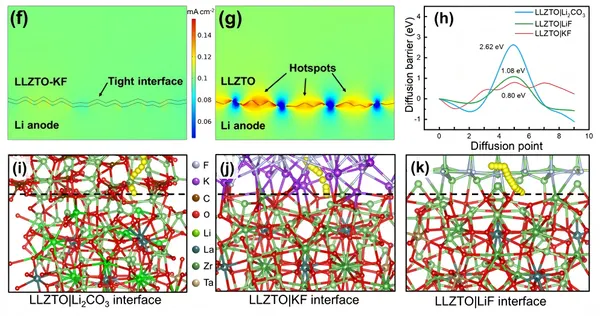
Battery
Reviewers requested supplementary calculations? Nat. Commun. Reviewer Comments Interpretation – Two Rounds of Responses and In-Depth Supplementary Calculations
When submitting to top journals, the most difficult step is often not producing the results, but rather providing sufficiently strong mechanistic evidence when reviewers press for "why." When reviewers from top journals raise rigorous questions about your physical mechanisms, how can theoretical calculations help you revive your work? This article will analyze a study on LLZTO solid electrolyte modification published in Nature Communications by Professor Liu Wei's team at ShanghaiTech University, along with their reviewers' comments. It will examine how the authors, facing continuous questioning during the review process, strengthened their arguments layer by layer, and, through first-principles calculations (DFT) and finite element simulations (COMSOL), gradually integrated the initially scattered results into a self-consistent and complete mechanistic loop.
Read Original
Battery
Sun Xueliang in Science: From experimental characterization to structural modeling, how should the structure of novel solid electrolyte materials be determined?
The successful synthesis of a new material does not mean the problem is solved; the real difficulties often lie ahead: What will it look like? How will its structure be determined? If there isn't even a ready-made crystal model, how can theoretical calculations be carried out?
Read Original