
Current Service Inquiry
Ion Migration
Calculation Purpose
Case Reference
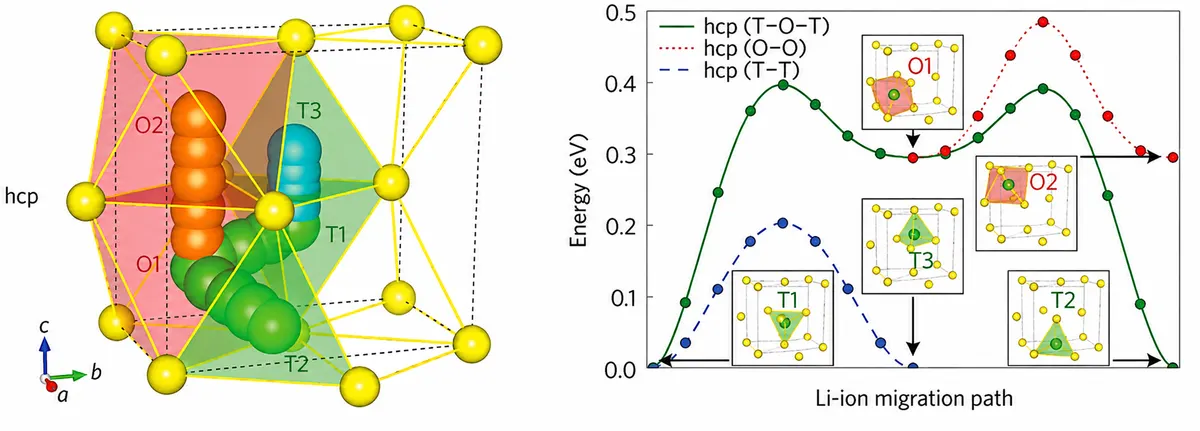
How is ion diffusion calculated? G Ceder interprets classic Nature Materials data
Ion diffusion is a type of calculation frequently used in papers on solid-state electrolytes, positive and negative electrode materials, and interfacial transport. The ion diffusion energy barrier, as commonly discussed, essentially calculates how high an energy peak an ion needs to traverse along the lowest energy path to move from one stable position to another. The smaller this value, the easier the ion typically migrates, and the faster the diffusion.
Nature Energy: Can electrolyte solvents also reversibly embed into layered cathodes? DFT, CI-NEB, and AIMD explain a new mechanism for ultra-fast charging sodium batteries.
In traditional sodium-ion batteries, it is generally assumed that only Na⁺ undergoes reversible insertion/extraction within the layered cathode, while the electrolyte solvent is only responsible for coordination and transport in the liquid phase. This work, published in Nature Energy by Qi Liu's team at City University of Hong Kong, proposes a different reaction scenario: in a diglyme electrolyte, solvent molecules can reversibly insert into the layered manganese-based cathode under high voltage, altering the interlayer diffusion environment and thus enhancing Na⁺ migration and bulk redox kinetics under ultrafast charging conditions.
Scan the QR code with WeChat for free consultation
Email: chengyankeji2026@163.com
WeChat QR Code