Current Service Inquiry
Coatings/Membranes/Protective Layers
Service Overview
Case Reference
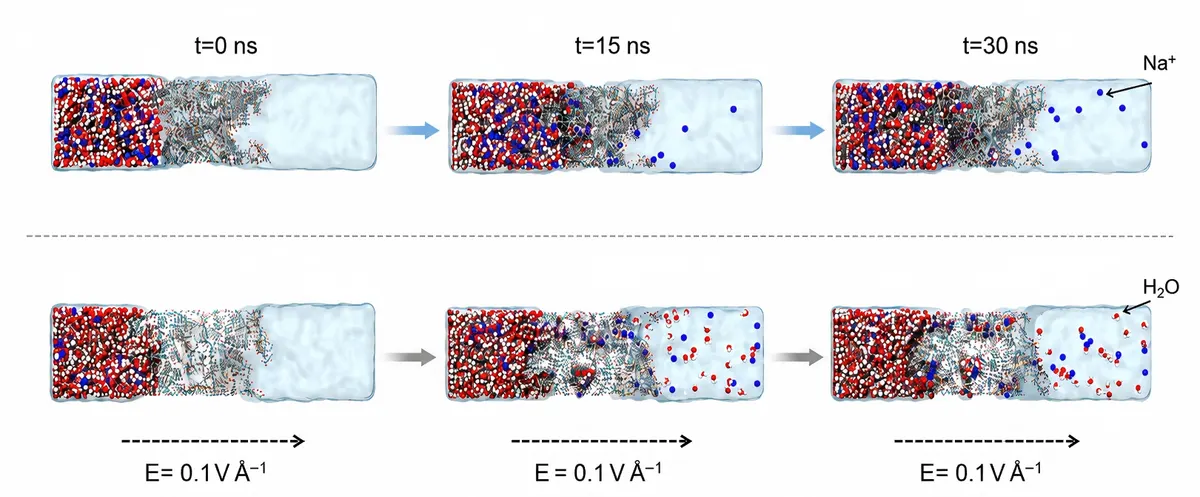
Case study from Nature Commun and Angewandte Chemie: How to use molecular dynamics (MD) to quantitatively analyze ion/water migration in membrane diffusion?
In battery development, experimental testing can tell us about macroscopic polarization and rate performance; however, how ions move within the membrane pores/interfaces often requires molecular dynamics (MD) to "see and explain." In battery membrane research, MD primarily undertakes three core tasks: 1. Visualizing transport paths: Visualizing the abstract "ion channels," intuitively showing whether ions creep along polymer chains or diffuse freely in water-filled channels. 2. Quantifying selectivity mechanisms: Calculating the migration rate and flux ratio of different ions in the membrane through non-equilibrium (NEMD) simulations of applied external fields, directly quantifying membrane selectivity. 3. Analyzing solvation effects: Accurately calculating the coordination number of ions, revealing the energy cost of "desolvation" or "water-carrying migration."
[Coating MD] From Micropores to Hierarchical Pores: What exactly should battery coating MD simulation be considered?
In battery research, the construction of coatings, such as artificial solid electrolyte interfaces (ASEI) or porous framework coatings on electrode surfaces, is a popular research topic. To thoroughly explain the mechanism of action of coatings in an article, molecular dynamics (MD) simulations are an indispensable tool. It is worth noting that the focus of MD calculations differs depending on the pore size. This article, based on five high-level papers, extracts the MD calculations of coatings into two core physical dimensions according to the material's pore size: ● Microporous systems (pore size 2 nm): Focusing on local solvation structures, long-range diffusion behavior, and the synergistic effect of hierarchical channels.
Scan the QR code with WeChat for free consultation
WeChat: 澄研科技
WeChat QR Code