
Current Service Inquiry
Lithium Sulfide Decomposition and Charging Kinetics
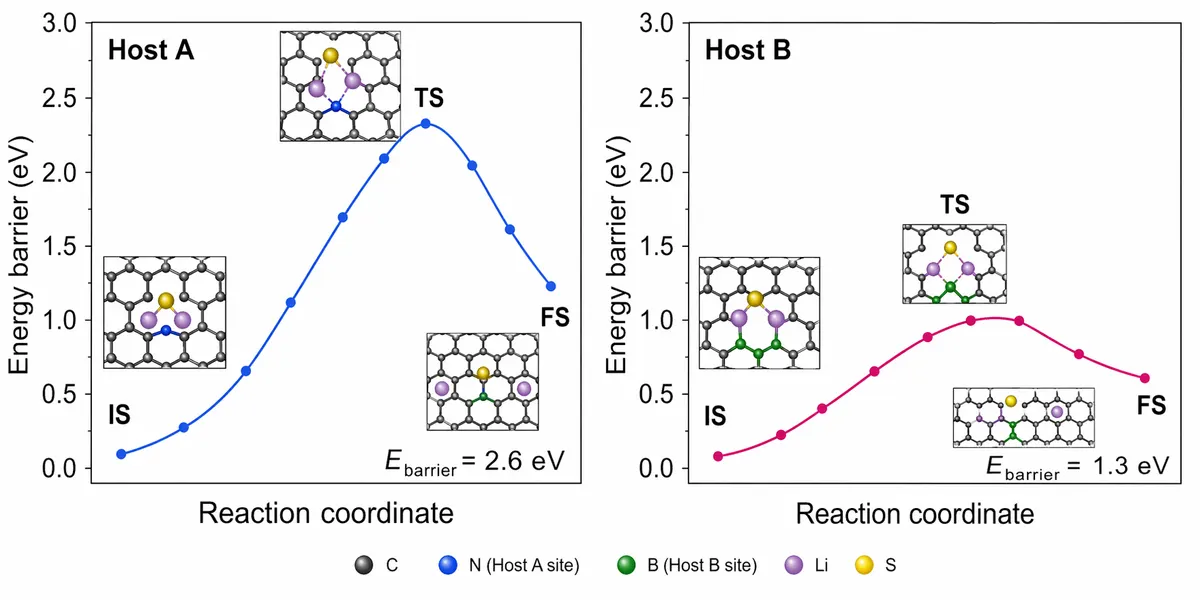
Calculation Purpose
Case Reference
Latest Nature report on lithium-sulfur batteries! Quantum chemistry + machine learning design of lithium-sulfur precursors.
Molecular mediators in lithium-sulfur batteries are essentially a class of organic molecular additives added to the electrolyte. They interact with polysulfides to alter sulfur conversion pathways, reduce reaction polarization, and improve the Li₂S deposition process. Past molecular additive design focused more on functional groups, such as their ability to bind polysulfides or promote Li₂S formation. This Nature paper by Zhou Guangmin's team at Tsinghua University's Shenzhen International Graduate School focuses on the molecular skeleton of organic additives: even within the CPyr class of molecules, different substituents and substitution sites simultaneously affect the rate at which the molecule is activated by polysulfides, as well as the charge transfer capability of the activated mediator.
Nature Catalysis: New Criteria for Lithium-Sulfur Catalysis: Theoretical Calculations Reveal that Energy Barriers Cannot Be the Only Factor in Lithium-Sulfur Reactions
In the past, when working with lithium-sulfur and lithium-oxygen systems, people were more accustomed to using thermodynamic indicators such as adsorption energy, reaction energy barrier, and free energy to screen catalysts. However, what truly blocks the reaction is often not whether the first step of the reaction can occur, but rather that the accumulation of insulating solid intermediates such as Li₂S₂ and Li₂O₂ blocks electron transport, making it increasingly difficult for subsequent reactions to continue.
Scan the QR code with WeChat for free consultation
Email: chengyankeji2026@163.com
WeChat QR Code