Current Service Inquiry
Interfacial Water Structure
Service Overview
Case Reference
Classic Article on Interfacial Water 1: Li Jianfeng's Computational Interpretation in Nature; In-situ Raman + AIMD Analysis of Pd Interfacial Water Structure and Dissociation Process
Interfacial water is a core foundation for reactions in electrocatalysis. Today, this article introduces a classic work frequently mentioned in the field of interfacial water—an article published in Nature in 2021 by Professor Li Jianfeng's team. The article focuses on interfacial water on single-crystal Pd surfaces under HER conditions, innovatively combining in-situ SHINERS Raman spectroscopy, single-crystal electrochemistry, and theoretical calculations. For the first time, it directly observes the structural change of interfacial water from disorder to order at actual reaction potentials, and further connects this change to the interfacial interaction of Na⁺, the water dissociation process, and HER activity.
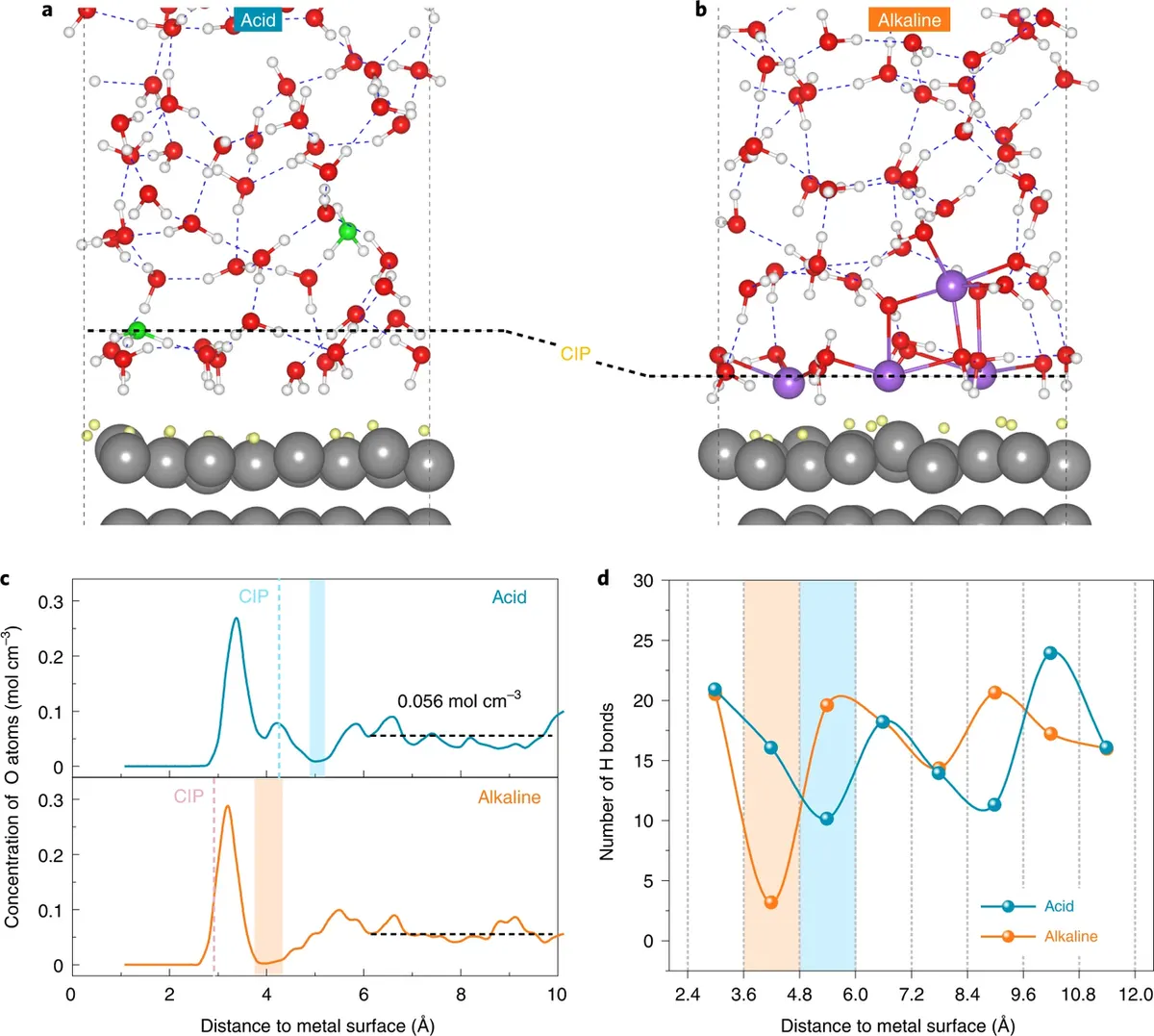
Interfacial Water Classic Article 2: Chen Shengli's Nature Catalysis: Why is HER/HOR slower in alkaline conditions than in acidic conditions?
In the previous article, we introduced a classic work in the field of interfacial water—an article published in Nature by Professor Li Jianfeng's team, which discovered that the increased proportion of Na⁺ hydrated water (Na·H₂O) at the interface under negative potential enhances HER activity. This article continues in this direction, introducing another classic article on interfacial water: a work published in Nature Catalysis in 2022 by Professor Chen Shengli's team, with Li Peng as the first author. Compared to the previous article, this paper focuses on the pH effect of hydrogen electrocatalysis, explaining why HER/HOR kinetics are slower under alkaline conditions.
Scan the QR code with WeChat for free consultation
WeChat: 澄研科技
WeChat QR Code