
Current Service Inquiry
Charge Transfer and Electronic Structure
Calculation Purpose
Case Reference
Nature Catalysis: New Criteria for Lithium-Sulfur Catalysis: Theoretical Calculations Reveal that Energy Barriers Cannot Be the Only Factor in Lithium-Sulfur Reactions
In the past, when working with lithium-sulfur and lithium-oxygen systems, people were more accustomed to using thermodynamic indicators such as adsorption energy, reaction energy barrier, and free energy to screen catalysts. However, what truly blocks the reaction is often not whether the first step of the reaction can occur, but rather that the accumulation of insulating solid intermediates such as Li₂S₂ and Li₂O₂ blocks electron transport, making it increasingly difficult for subsequent reactions to continue.
Nature Catalysis: Cation-doped ZnS reveals the volcano-like relationship between adsorption and activity in lithium-sulfur catalysts
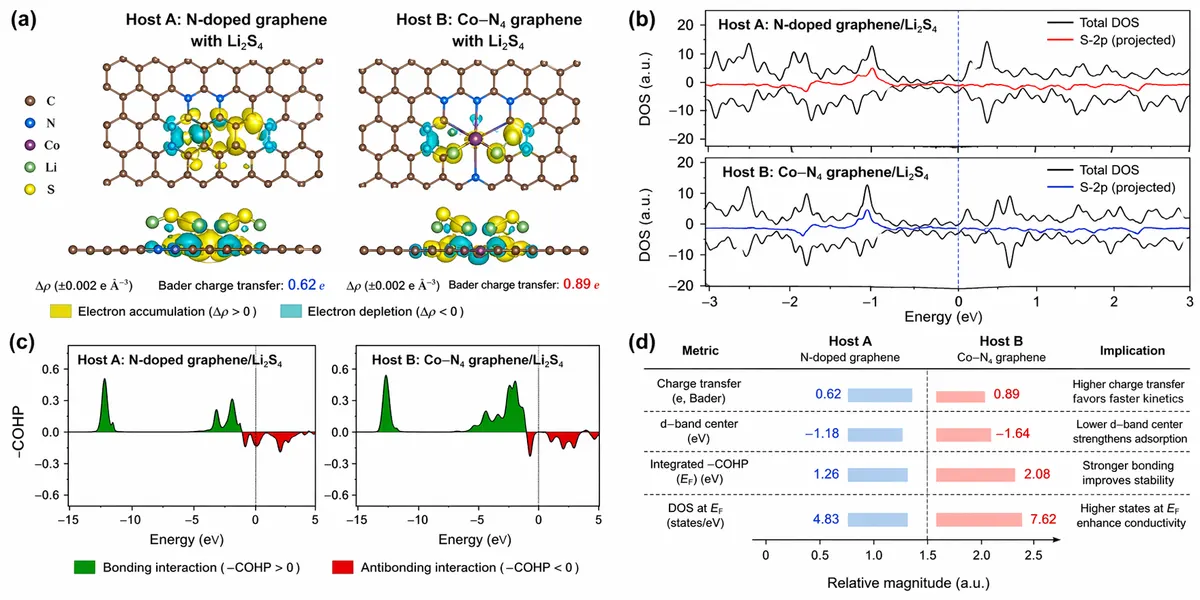
In lithium-sulfur batteries, slow polysulfide conversion exacerbates the shuttle effect and capacity decay. This paper uses ZnS as the parent material and introduces Mn, Fe, Co, Ni, and Cu cations for doping, systematically regulating the polysulfide adsorption intensity. A volcano-like relationship was found between catalytic activity and adsorption intensity, with Co₀.₁₂₅Zn₀.₈₇₅S exhibiting the optimal catalytic effect. Theoretical calculations using DFT adsorption energy, d-band centers, Bader charge, differential charge density, COHP/iCOHP, and a microkinetic model demonstrate that moderate adsorption intensity is beneficial for simultaneously promoting Li₂S₄ conversion and Li₂S₂/Li₂S desorption.
Scan the QR code with WeChat for free consultation
Email: chengyankeji2026@163.com
WeChat QR Code