
Catalysis
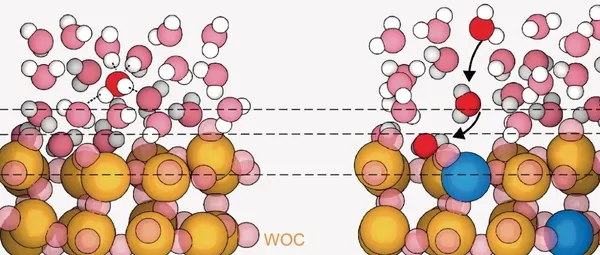
Nat. Commun.: How does Ni doping rearrange interfacial water? AIMD+DFT analysis of benzylic C(sp3)–H oxygen transfer
Read OriginalWater can serve as a clean oxygen source for organic oxidation, but directly activating water and inert benzylic C(sp3)–H bonds usually requires a high potential, which readily triggers the oxygen evolution reaction (OER) at the same time and lowers the Faradaic efficiency. In this Nature Communications work, Xin-Hao Li’s group at Shanghai Jiao Tong University reports that a Ni-doped W₂C precatalyst reconstructs in situ into Ni–WOC. Using explicit-water AIMD to compare the interfacial hydrogen-bond network, and combining RDF, d-band center, Bader charge, water adsorption energy, and reaction free energies, they explain how Ni doping rearranges interfacial water and steers *O toward benzylic oxygen transfer rather than further oxygen evolution.
Read Original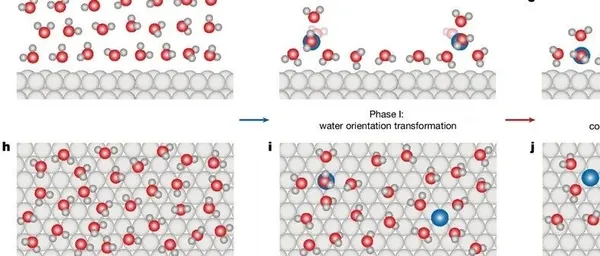
Catalysis
Nature: Why does the electric double layer contract? MLMD reveals the field-enhancement mechanism
Read OriginalThe electric double layer at an electrocatalytic interface changes with potential and affects the local electric field and reaction environment. This Nature work studies how the double layer at a Pt electrode changes under hydrogen-evolution conditions: as the potential is gradually shifted negatively, interfacial water first adjusts its orientation and hydrogen-bond network; K⁺ then partially dehydrates and approaches the electrode, causing the inner layer to contract and further enhancing the local electric field. The authors use machine-learning molecular dynamics (MLMD) to analyze interfacial water vibrations, hydrogen bonds, hydration structure, and ion distributions, and then employ a compressible double-layer model to explain how the electric field changes for different cations and at different interfacial locations.
Read Original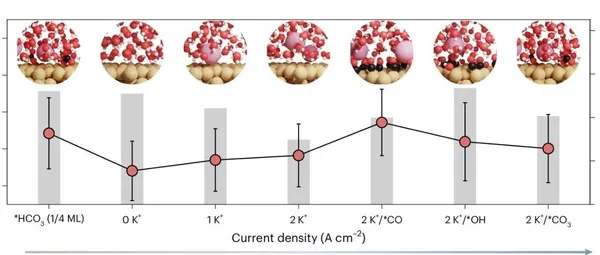
Catalysis
Nat. Catal.: AIMD analysis of interfacial water gating in CO₂ electrolysis
Read OriginalIn CO₂ electrolysis, raising the current density does not necessarily yield more multicarbon products. Besides the catalyst itself, the water, ions, and adsorbates covering the electrode surface are also changing, affecting whether reactants can approach the surface and how the protons required for the reaction are supplied. This Nature Catalysis work combines operando Raman spectroscopy with ab initio molecular dynamics (AIMD) and proposes an “interfacial water gating” mechanism: K⁺ and adsorbates alter the hydrogen-bond network of water, while the electric field further adjusts water orientation; together they shape the competition between CO₂ reduction and hydrogen evolution.
Read Original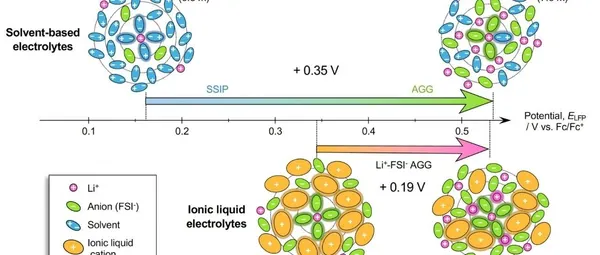
Battery
JACS: Looking at electrode potential with MD, the second coordination shell is key
Read OriginalWhen the lithium-salt concentration increases, the electrode potential often shifts upward, and one usually starts from the coordination structure around Li⁺. This JACS work finds that in ionic liquids, the first coordination shell changes very little, yet the potential still rises substantially, showing that looking only at the anions immediately next to Li⁺ may miss the key contribution. Atsuo Yamada’s group at the University of Tokyo extends liquid Madelung theory to ionic liquids and, using all-atom molecular dynamics (MD) to calculate the electrostatic interactions between Li⁺ and surrounding species, shows that enhanced repulsion from an increased number of Li⁺ ions in the second coordination shell is an important reason for the potential upshift in such systems.
Read Original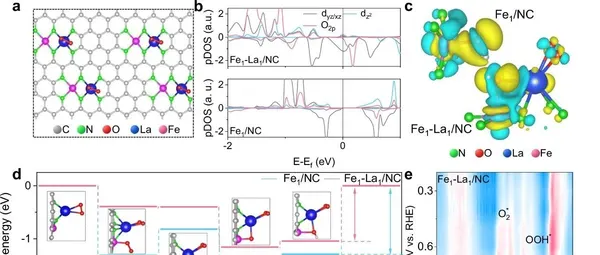
Catalysis
Nat. Commun.: Introducing La next to Fe simultaneously improves acidic ORR activity and stability
Read OriginalIn the acidic oxygen reduction reaction (ORR), Fe–N–C catalysts must address two problems at once: oxygen-containing intermediates bind too strongly, which can limit the reaction; and the Fe site can lose its coordination during operation, which affects lifetime. Teams including Harbin Institute of Technology, the Institute of High Energy Physics of the Chinese Academy of Sciences, and the National Center for Nanoscience and Technology report a Fe–La dual-atom catalyst in Nature Communications. Combining DFT with operando spectroscopy, they find that La both modulates the spin and coordination structure of Fe and participates in interactions with oxygen-containing intermediates, thereby improving acidic ORR activity and stability.
Read Original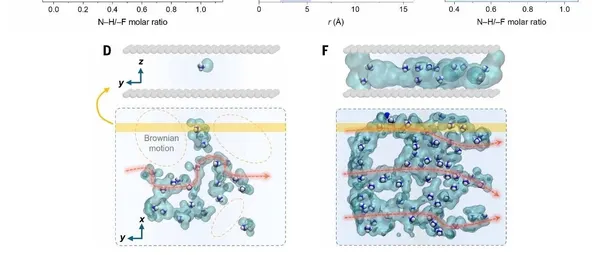
Porous materials and separation transport
Science: Why does water transport faster when ammonium ions rotate? DFT and MD analysis of the transport mechanism in MXene membranes
Read OriginalMXene interlayer channels are already narrow, and introducing additional ions often further restricts water transport. This Science work finds that after introducing NH₄⁺ into the MXene interlayer, water transports faster while ethanol is hindered. The authors link this to the rotation of ammonium: position-restricted NH₄⁺ can still reorient and help nearby water exchange and migrate. Combining DFT, AIMD, and classical MD, they explain, from stable configurations and rotational controls to hydration structure and migration trajectories, why ammonium stays in the channel and how it speeds up water transport.
Read Original